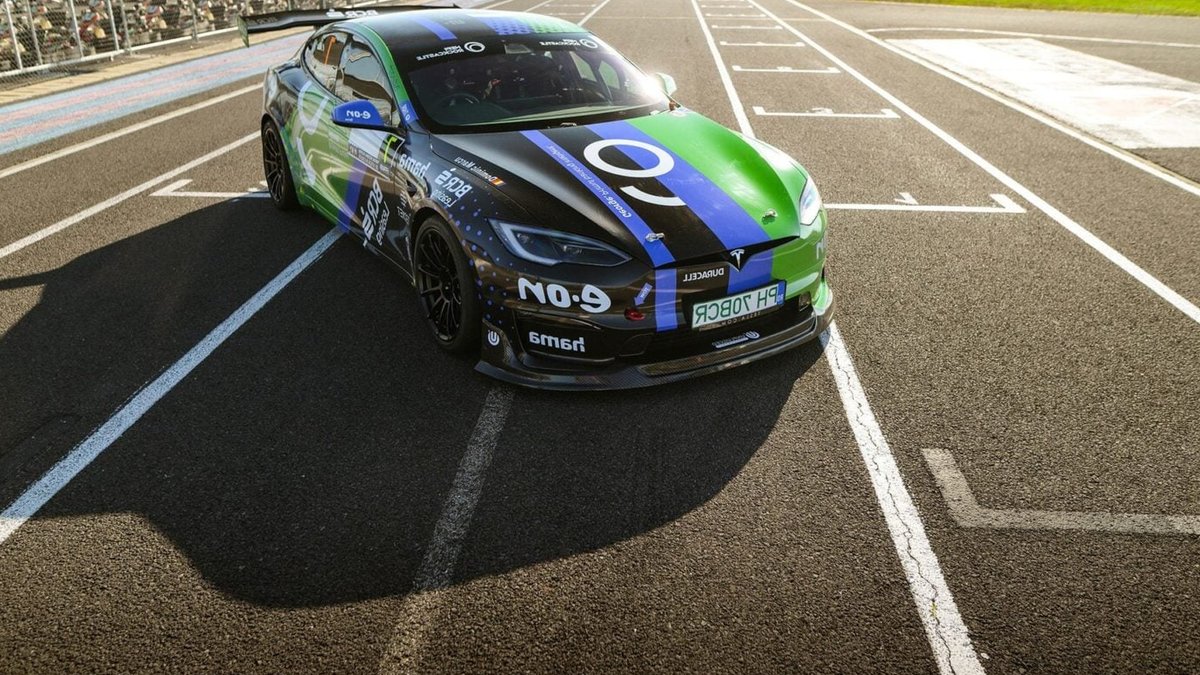
Unplugged Performance and Dominic Marcu have built a winning narrative around a high-horsepower Tesla sedan on European mountain roads. The centerpiece of this project is a Tesla Model S Plaid hill climb build that utilizes a tri-motor setup producing 1,020 horsepower, forged wheels, and spherical bushings to tackle Romanian courses. Since 2021, the results from this collaboration have been consistently strong, marking one of the most compelling electric vehicle racing stories on the continent.
A Car That Defies Expectations
Before any modifications, the Model S Plaid is already a genuinely absurd machine. Three electric motors and all-wheel drive provide a claimed 0-60 mph time of 1.99 seconds, making it one of the fastest-accelerating production cars ever built. The quarter mile falls in under 9.3 seconds, and the top speed is rated at 200 mph. Despite weighing over 4,800 lbs, the car pulls harder off the line than most dedicated sports cars.
The raw power comes from a front motor paired with two rear motors, working through Tesla’s torque vectoring logic. There is no clutch slip, turbo lag, or gear change interrupting the pull. The force is instant. This platform intelligence is a competitive asset for hillclimb events where surface conditions shift rapidly from dry patch to slick mud.
Related: Novitec Unleashes 1,048 hp Purple Lamborghini
However, raw power is only part of the equation. Hillclimb stages at locations like Sinaia and Transalpina feature tight switchbacks and changing grip levels. Power gets you up the straight sections, but stability and consistency on corners are where a stock sedan often fails. That is the gap Unplugged Performance seeks to close with hardware changes.
The core philosophy for this build was tested at the 101st Pikes Peak International Hill Climb. Driver Randy Pobst piloted a Model S Plaid titled “Dark Helmet” to a sub-10-minute run of 9:54.901. This set a new record for modified production EVs and finished second in class out of 66 drivers. The critical detail is that “Dark Helmet” ran a factory powertrain; Unplugged Performance only altered the chassis, suspension, brakes, wheels, and aero to achieve this result.
For the driver, the challenge is never just about hitting a top speed; it is managing the inertia of a heavy, aerodynamic bullet through hairpin turns. When the road dives into a valley and then climbs sharply, the suspension needs to react faster than the driver’s brain can process, turning a 4,800-pound luxury sedan into a precise instrument rather than a rolling projectile.
The Physics of the Race
Hillclimb stages eliminate the safety net that closed circuit racing provides. There is no run-off area. The surface changes between runs, and grip evolves as the day heats up. Every driver gets a handful of timed passes, and there is no coming back from a mistake that puts two wheels over a barrier.
Related: Gorgeous Arancio Apodis Temerario on Vossen Wheels
The discipline also punishes inconsistency harshly. A car that posts a competitive time on one run but degrades on the second, because brake temperatures climbed or geometry shifted under load, will lose to a slower but more repeatable setup. This argument for repeatability is at the core of what Unplugged Performance brings to competition. Their philosophy is that boring, working parts win weekends. Get the geometry right, keep it right, and let the driver focus on driving.
The suspension and alignment work centers on precision springs, dampers, and adjustable camber solutions, which gives the setup range a street-born EV simply doesn’t have from the factory. At Pikes Peak, the team used UP x Ohlins TTX 4-way coilovers and billet aluminum control arms to manage the transition between the high-speed lower section and the rough upper mountain. They swapped front springs at 1 a.m. to balance the car, a process that paid off during competition.
Chassis precision comes from replacing rubber bushings with spherical units. Rubber bushings deflect under load, introducing vagueness in steering feel and causing geometry to shift unpredictably. Spherical units eliminate that slop, ensuring the geometry set in the paddock remains constant lap after lap.
The wheel and tire package is built around UP-03 Pikes Peak Spec forged wheels, motorsport-rated for the fitment required by competitive hillclimb. At Pikes Peak, “Dark Helmet” ran UP forged wheels wrapped in Yokohama A005 Biomass tires, and Pobst specifically credited the wheel-and-tire combination as a key factor in the record. Lighter rotational mass means faster direction changes and reduced load on the wheel bearings under sustained cornering forces.
Related: Australia’s top-selling hybrids in 2026
Functional aero and brakes round out the package: splitters, lips, and a diffuser designed for real-world hillclimb speeds. A Superlight Carbon Ceramic Big Brake Kit with a Carbon Fiber Brake Cooling Duct Kit is essential at high altitude to prevent fade. At 14,115 ft of altitude, brake consistency isn’t optional. A driver who trusts consistent brakes can attack a stage on the final run the same way they did on the first, which separates a good time from a winning one.
Romanian Success
Dominic Marcu has been the most visible EV competitor in Romania’s CNVC since 2021. He has raced iconic stages including Sinaia, often compared to Monte Carlo for its street course character, and the elevation and rhythm of Transalpina. Over that span, he has accumulated category wins, podiums, and EV firsts.
He is now transitioning to a Tesla Model 3 Performance for the next competitive chapter. The logic is sound; the Model S answered the power question definitively, but the Model 3 is a lighter, more nimble platform that asks for a different kind of driving. Unplugged Performance is building the new car around the same foundation: ride control, alignment hardware, forged wheels, and functional aero. The iterative process that built the Plaid campaign into a winning program—build, test, learn, refine, repeat—applies directly to the new platform.


