
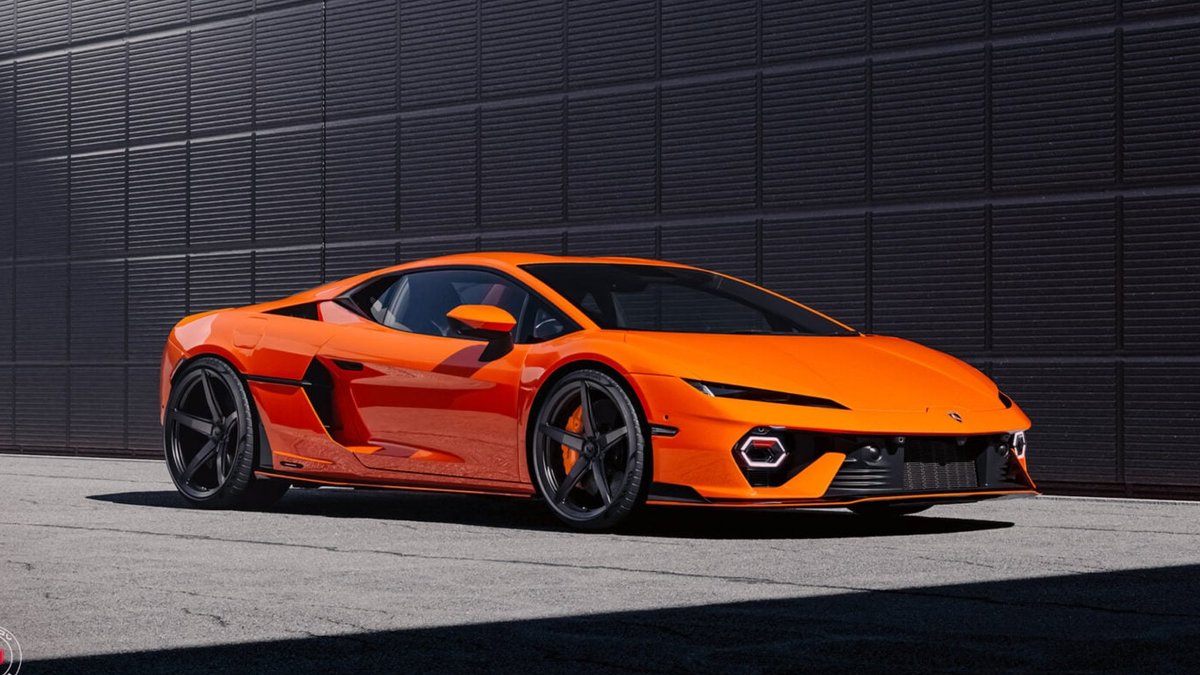
The Lamborghini Temerario replaces the Huracán as Sant’Agata’s entry-level supercar, and the new model is a generational leap by every measurable metric. The car uses a brand-new twin-turbocharged 4.0-liter flat-plane V8 working alongside three axial-flux electric motors. This hybrid system produces a combined 920 CV (907 horsepower) and 730 Nm (538 lb-ft) of torque, enough to launch the car from 0 to 100 km/h in just 2.7 seconds and reach a top speed of 343 km/h. This particular example finished in the stunning Arancio Apodis paint and sitting on a set of Vossen Forged VPS-3 wheels makes an already spectacular machine look even more aggressive.
The Huracán was a phenomenal car over its decade-long production run. It evolved from a “softer” alternative to the Aventador into a genuine supercar benchmark, with the Performante, Tecnica, and STO pushing the V10 formula to its limit. Replacing that naturally aspirated 5.2-liter V10 with a turbocharged V8 was always going to be controversial, but Lamborghini has made it work by going in a direction nobody else has. The new flat-plane crank V8 revs to an astonishing 10,250 rpm redline, the highest of any turbocharged production engine on the market. Titanium connecting rods, DLC-coated finger followers, and a short-stroke design allow it to spin freely into five-digit territory, delivering a character that feels closer to a naturally aspirated screamer than a typical forced-induction engine.
A New Direction for the V8
The V8 alone produces 800 CV between 9,000 and 9,750 rpm. Add the three electric motors—two on the front axle for on-demand e-AWD and torque vectoring, plus one P1 unit integrated between the engine and the 8-speed dual-clutch gearbox—and the combined output reaches that headline 920 CV figure. The hybrid system isn’t just about raw power, either. The P1 motor acts as a torque-fill unit during gear changes, eliminating the hesitation that plagues most DCT setups. The front axle motors give the Temerario genuine torque-vectoring capability, allowing it to rotate into corners with a precision the Huracán never had. Lamborghini’s updated LDVI 2.0 system predicts available grip in real time and adjusts power delivery to each wheel independently. Paired with four distinct driving modes and up to 13 powertrain combinations, the Temerario is as adaptable as it is fast.
Related: Honda Super One pricing revealed in Australia
From a design standpoint, the Temerario is a clear evolution of Lamborghini’s current language, but with its own identity. The hexagonal daytime running lights are a signature touch, giving the car a futuristic face that sets it apart from the more rounded Huracán. The shark-nose front end channels air efficiently to feed both the radiators and the underbody aero elements, while the concave roof profile directs airflow toward the rear active spoiler. Out back, the exposed engine bay is a dramatic visual statement, and the functional diffuser ties the overall shape together, making it as aerodynamically effective as it is visually striking. In Arancio Apodis, all of those design details come to life. The vivid orange finish highlights every crease, vent, and surface transition in a way that darker colors simply cannot.
The Vossen Forged VPS-3 is one of Vossen’s signature monoblock forged designs, and on this Temerario, it looks absolutely right. Vossen manufactures its forged wheels entirely in-house at its Miami, Florida headquarters, a TUV-verified facility equipped with state-of-the-art CNC machinery. Each VPS-3 is machined from a single billet of 6061-T6 aluminum, resulting in a wheel that is both significantly lighter and stronger than a comparable cast unit. That matters on a car like the Temerario, where reducing unsprung mass translates directly into sharper turn-in, better ride quality, and improved braking response.
The VPS-3’s design language is clean and aggressive: a five-spoke layout with deep concavity that fills the Temerario’s large wheel arches with real visual presence. There are no unnecessary flourishes or overcomplicated spoke patterns here. The spokes are thick, structural, and purposeful, giving the wheel a motorsport-inspired look that suits a mid-engine supercar far better than a delicate multi-spoke design ever could. Vossen takes precise measurements from over 100 data points around each specific vehicle, so the fitment is tailored, not guessed at.
Related: 2026 Nissan Ariya Advance+ EV roadtrip review
This particular Temerario runs a staggered setup with 21×9.5 and 22×12.5 wheels at the front and rear, with 255/30/22 tires up front and 335/25/22 in the rear. That’s a serious footprint, especially at the rear, where the wide 12.5-inch barrel and 335-section tire ensure a maximum contact patch to put down all that hybrid power. The chosen finish is Satin Black, which creates a fantastic contrast against the Arancio Apodis paintwork. Satin Black sits in that sweet spot between matte and gloss, giving the wheels a sophisticated, understated look that lets the car’s color do the talking. It’s a finish that darkens the Temerario’s stance without making the wheels disappear, and it pairs particularly well with the black accents already present on the car’s aero elements and window surrounds.
While the factory options for the Temerario are impressive, the Vossen Forged VPS-3 wheels transform the car’s visual presence, adding a level of customization and refinement that the stock wheels simply don’t match. The combination of forged construction, aggressive concave styling, and that perfectly chosen Satin Black finish creates a stunning machine. Lamborghini’s engineering focus on precision and power mirrors the advancements seen in the automotive industry, pushing boundaries further with every new release.


