
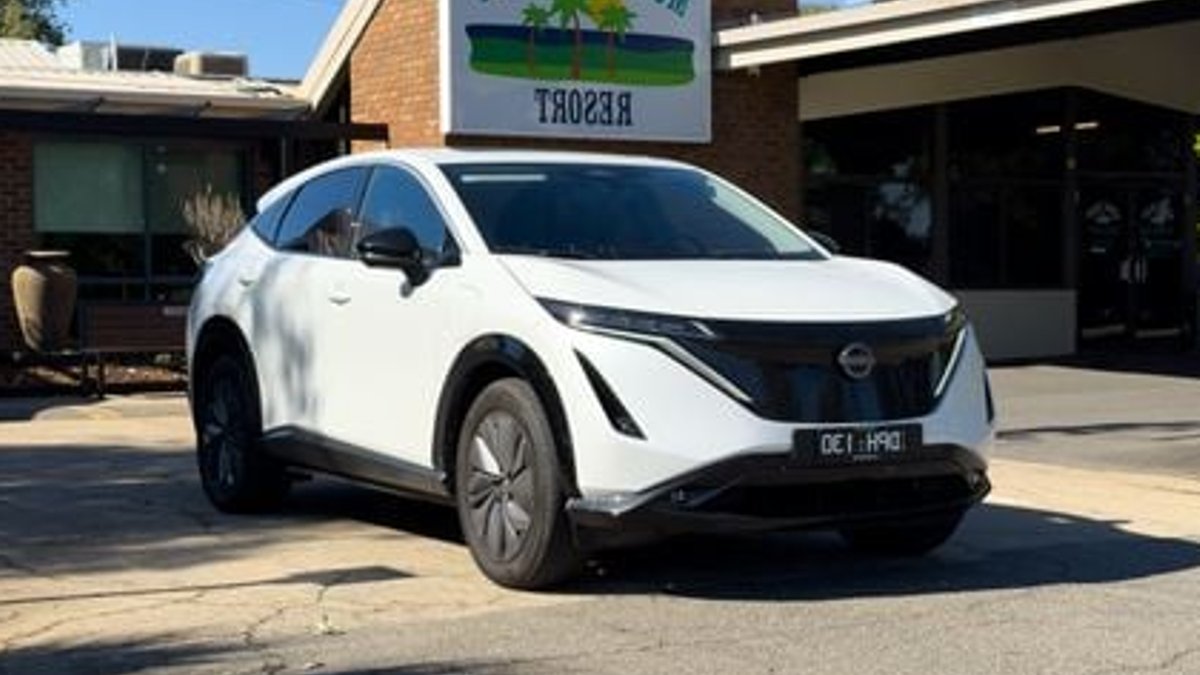
The idea that electric vehicles cannot handle long weekends — a phrase once used by a former Australian government — is fading, but range anxiety remains a real barrier for many buyers. To test whether the kind of road trip Australians regularly take is actually feasible in an EV, I drove a 2026 Nissan Ariya Advance+ from Melbourne to Yarrawonga on the Victorian-New South Wales border over the Easter long weekend.
The trip from my home in Melbourne’s eastern suburbs to Yarrawonga is roughly 280km each way. It is gradually uphill and mostly spent at freeway speed on the Hume Highway — about the worst conditions for an EV’s efficiency.
A fully charged start and a firm ride through town
I packed my partner and luggage into the Ariya after topping it up using a garage wall socket, which showed an indicated 599km of range at the start. The 466-liter boot handled duffel bags, tennis gear and holiday odds and ends without issue.
The Advance+ rides on 19-inch wheels, smaller than the 20-inch set on the top-spec Evolve model. I was curious whether this would smooth out the ride. It did, somewhat — but not enough.
Through the north-eastern suburbs toward Melbourne’s Ring Road, the Ariya’s firm suspension felt crashy over pockmarked blacktop. The rear end often felt unsettled and pogo-ey in town. Nissan’s decision to use a stiff tune seems like an oversight for a vehicle that is not pitched as sporty.
Related: Dutch supercar maker Donkervoort enters Australia
Things improved on the freeway.
At highway speed, the cabin is reasonably quiet, and the Bridgestone Alenza tyres (235/55 R19) help. Energy consumption hovered around 21kWh/100km.
ProPilot helps, but the road surface does not
The Ariya’s ProPilot system — combining adaptive cruise control and lane centering — was a handy co-pilot. It managed gaps well, though I occasionally found the following distance too conservative for Victorian traffic habits.
The single-motor EV’s 0-100km/h time of 8.1 seconds sounds slow by EV standards, but the immediate torque makes it feel quicker in real-world driving. The front motor develops 178kW and 300Nm to shift 2078kg — figures that would have been impressive for a V6 not long ago.
Off the Hume, I did a couple of B-road overtakes with little trouble. The crossover struggled more with uneven country roads. Every lump and bump transmitted into the cabin. It is rarely harsh, but it is not luxurious either — and if you have nausea-prone kids, it is not ideal.
Related: Algae diesel tested in two VW TDI models
The standard LED headlights with auto high-beam worked well on poorly lit regional roads after sunset. The 10-speaker Bose audio system was a welcome companion, with crisp sound and enough bass to drown out road noise.
Real-world range and a charging stop
After arriving in Yarrawonga, the trip computer showed 20.3kWh/100km over the distance at an average of 81km/h, with 216km of remaining range from 43% charge. That works out to about 490km total — close to the manufacturer’s claimed 504km on the WLTP cycle.
I used a 50kW DC charger in town. The model can accept up to 130kW DC, which is slower than key rivals. I could not find a way to cap the charge at 80% — generally recommended for battery longevity — so I left it plugged in while grabbing breakfast.
The car was on the charger for 1 hour 19 minutes and 3 seconds, taking in 57.477kWh. It went from just over 30% to just under full capacity. The Evie network charged me $42.53. Indicated range after charging was 484km — more than enough for the return trip.
Minor annoyances and a dated infotainment system
The climate control felt weak for a car parked in mid-20s to low-30s temperatures. The Advance+ does add heated and ventilated front seats, and the suede upholstery inserts will not burn your skin in the sun.
Related: CATL and Nio to build biggest EV battery swap network
Cabin storage is limited. The shallow center armrest cubby barely holds keys alongside the wireless charger, and the door bins will not fit larger bottles. The electrically adjustable front console is a neat feature, but items stored there can slide into the driver’s footwell in tight corners.
The steering wheel controls are mechanical buttons grouped under plates that feel like capacitive touch clusters — they are fiddly and lead to mis-presses. The dual front glove boxes and large toothed cupholders under a sliding lid add some practicality.
Compared to what Tesla, Chinese brands, VW and Skoda are doing with packaging, the Ariya could be better. The interior design is clean and classy, with soft-touch materials, wood-effect trim and solid switchgear. But the infotainment software looks dated. A facelifted version with Google Built-in integration is already on sale in Japan, but it is unclear when that reaches Australia.
The Ariya Advance+ originally launched at $63,840 plus on-road costs. Right now, drive-away deals start from $61,990. That is still more than a BYD Sealion 7 Premium ($54,990) but nearly $3,000 cheaper than a base Tesla Model Y drive-away. It is also competitive with the Hyundai Ioniq 5 and Kia EV5. For reference, the full range runs from the Engage at $49,990 drive-away up to the Evolve e-4ORCE at $75,990 drive-away, with special pricing valid for vehicles purchased between July 1 and July 31, 2026, and delivered by August 31. The firm ride, limited storage and dated software work against the clean design. But its long real-world range, familiar Nissan interior feel and sharp pricing make it a credible option for buyers who want an EV that can actually do a weekend away — as long as you plan your charging stops.


