
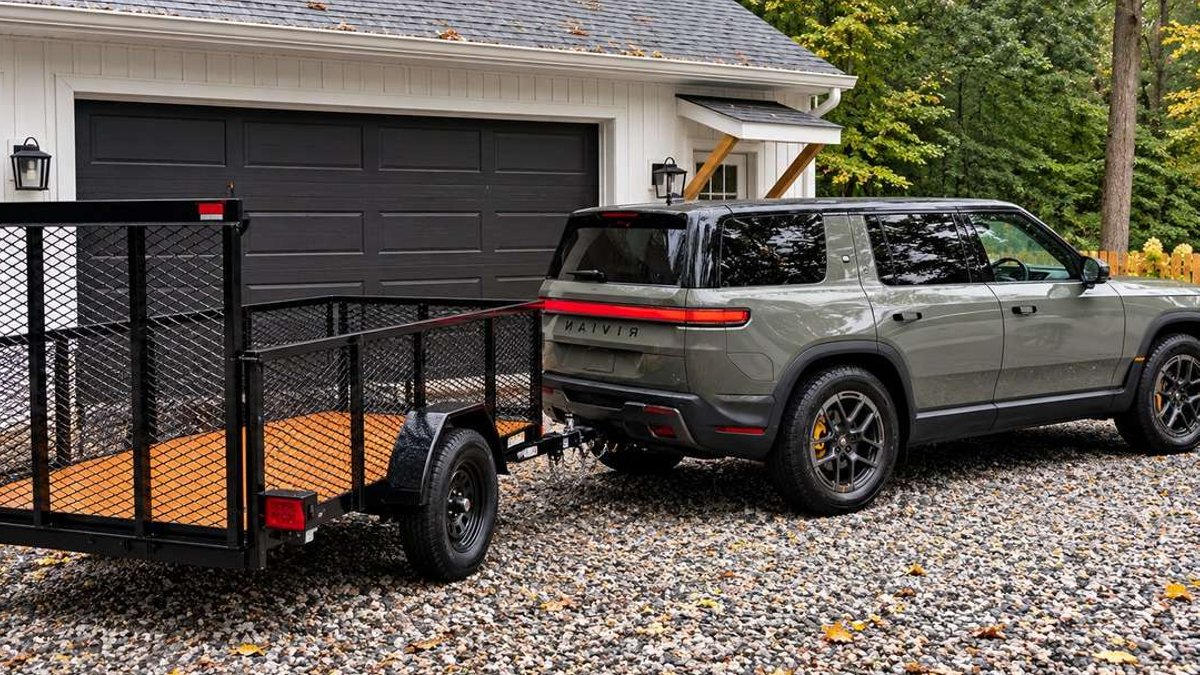
A 750-pound utility trailer should pose little challenge for an electric SUV. However, David Hall, who recently towed one using a Rivian R2, discovered the task more involved than anticipated—and his findings ignited discussion among owners.
In a post to the Rivian R2 Enthusiasts Facebook group, Hall detailed a 130-mile test with a 5-by-8-foot trailer, recording 2 miles per kilowatt-hour (mi/kWh) at 65 mph and a 170-mile range estimate. His conclusion was clear: “Did better than expected!”
Not all agreed. Nic Rockhill, another contributor, wrote, “That’s poor range for such a light trailer.” Others focused on the upright loading ramp—a standard feature, claiming it introduced unnecessary drag. The debate exposed a fundamental question: What constitutes a good towing range?
Two Figures, Two Conflicting Interpretations
The discrepancy stems from Hall’s two reported numbers: 130 miles driven and 170 miles of range. These metrics describe different things.
The 130-mile trip reflects the actual test, conducted with the trailer attached. The 170-mile range likely came from the vehicle’s display, either the EPA-estimated range or a real-world estimate, but it does not reveal how much charge Hall began with or how much remained after the test. Without those specifics, it remains unclear whether he depleted the battery or merely used a portion.
His 2 mi/kWh average suggests roughly 65 kWh of energy consumption over 130 miles, assuming the figure applies to the entire journey. Yet this does not account for battery reserve. For long tows, arriving with a 20% buffer holds greater importance than maximizing every mile.
Wes Grycki proposed removing the ramp to improve efficiency. Chris McGeary and Chad Fawcett both emphasized aerodynamics, arguing that even a lightweight trailer disrupts airflow at highway speeds. The ramp, despite its mesh design, still creates drag, particularly when combined with the SUV’s turbulence.
Research from NASA confirms this: shape, size, and airspeed determine drag. An upright ramp, even if less solid than a flat panel, forces air to separate and reattach, increasing resistance. While trailer weight affects rolling resistance and acceleration, aerodynamics dominate at speed. A light trailer can still feel burdensome if its design is poor.
Range Loss Is More Complex Than It Appears
Rockhill’s critique—“near-half its range” for a small trailer, assumes a direct comparison to the R2’s advertised range. Yet towing does not follow such a straightforward calculation.
Hall’s post lacks critical context: no unhitched baseline run, no battery percentage logs, no notes on wind, temperature, or elevation. Rivian’s 4,400-pound towing rating describes capability, not efficiency. A 750-pound trailer—just 17% of the limit—does not guarantee a 17% range penalty. Real-world performance depends on aerodynamics, terrain, and driving habits.
Another commenter described getting close to 2 mi/kWh while towing a much heavier load with an R1S, proving efficiency varies widely. Hall’s results do not prove the R2 performed exceptionally well or poorly, they simply demonstrate that towing range is context-dependent.
Consider the Rivian R1T family that towed an Airstream camper for a long trip. Their charging stops accommodated feeding a baby. A delivery driver with the same setup would view those stops as delays. Range extends beyond miles, it involves flexibility.
Hall’s test reveals that even small trailers require careful planning. A 5-by-8-foot utility hauler may seem straightforward, but at 65 mph, air resistance accumulates. The ramp, the trailer’s contours, and the SUV’s own drag all influence efficiency.
Hall came back pleased with what his trailer trip delivered. Yet the discussion highlights a broader reality: towing range is not a fixed value, it is a balance.
For light loads and short distances, the R2’s efficiency may exceed expectations. For multi-day trips with limited charging opportunities, more precise data is essential. A repeat tow with recorded battery percentages would show what reserve Hall could expect. A run without the trailer would reveal the exact efficiency loss. Without these details, buyers must rely on speculation.
The R2’s towing capacity is strong, but real-world efficiency varies by use case. A homeowner moving furniture may disregard mi/kWh. A truck driver swapping fuel stops for charging will prioritize it. The same vehicle, trailer, and route can yield different outcomes for different drivers.
Hall’s experience provides one data point: a light trailer does not guarantee efficiency. The ramp’s design, cruising speed, and the SUV’s drag all play roles. For long tows, unexpected challenges remain, even with electric vehicles.


