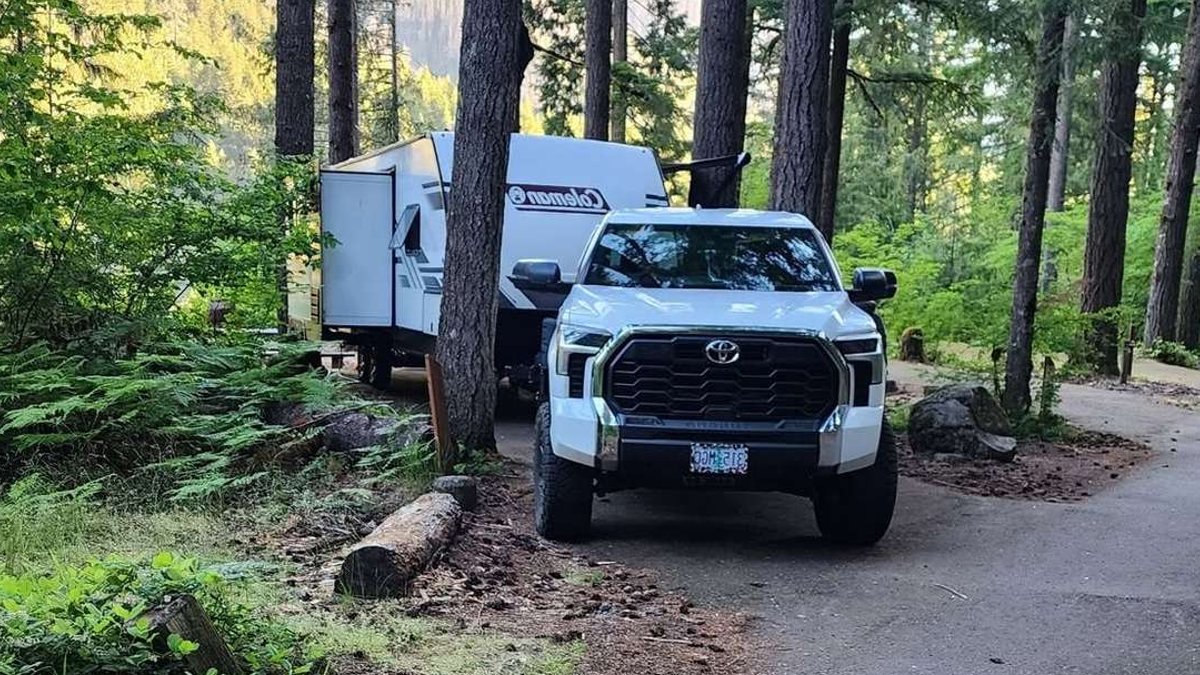
A 2025 Toyota Tundra with a six-inch lift reportedly applied its front brakes during a slow right-hand turn while towing a camper, according to an owner who said the intervention nearly pushed him into the opposing lane. The driver, Brian Goodwin, estimated he was traveling between 10 and 15 mph as he entered a corner marked for 20 mph, yet the truck still intervened hard enough that Goodwin said it “almost caused me to go in the other lane.”
Goodwin shared his experience in the public 2023-2027 Toyota Tundra Owners Facebook group, describing a specific and potentially dangerous pattern. “Ever since we have had the Tundra, certain corners the traction control kicks on and slows us down even when we are not going that fast,” he wrote. The latest event occurred while towing his camper through a downhill U-shaped corner, where Goodwin reported that the truck “locked up my front brakes.”
The owner also identified an unusual trigger: right turns appear to provoke the system more readily than left turns. Several commenters recognized the description. Ryan Alvarez said his three-inch-lifted truck has intervened on downhill freeway ramps even without a trailer, while Jared Yali reported similar behavior on freeway entrance ramps. Robby Sigler described a lifted 2015 Tacoma that reacted most often on downhill right-hand corners.
Those accounts justify further reporting. They do not establish that the trucks share one defect. Different generations, lift kits, tires, alignments, sensors, trailer setups, and repair histories can produce symptoms that sound similar from the driver’s seat.
Related: Subaru Owner Travels 2.5 Hours for Third Outback but Finds Hood Too High
Lift Height and Calibration Questions
Toyota offers its own suspension lift for the current-generation Tundra, but the factory-engineered package is smaller than Goodwin’s setup. The official TRD lift kit raises the front of the Tundra by three inches and the rear by two inches. Toyota describes it as the only Toyota-approved lift kit compatible with the truck’s Toyota Safety Sense system and specifically warns that aftermarket lifts can affect active safety features.
That does not prove the six-inch lift caused Goodwin’s braking event. It does establish that his truck sits outside the configuration Toyota highlighted when it explained how its approved lift preserves safety-system operation. Toyota News previously examined a 2025 Tundra with Toyota’s factory three-inch lift towing a 4,700-pound Coachmen Apex Nano. The appeal of that setup was integration. The suspension, safety systems, tire package, alignment, and towing geometry began as one engineered combination.
Goodwin’s six-inch truck needs a different level of documentation. Which kit did the dealership install? What tires and wheels were fitted? Was the steering-angle sensor checked? Was a yaw-rate and acceleration-sensor zero-point calibration performed? Does the invoice show a camera or radar calibration? What alignment readings did the truck have before and after the work?
Until those records surface, “recalibrate the yaw sensor” remains a plausible diagnostic suggestion rather than a verified repair. The combination of a six-inch lift and a heavy trailer changes the vehicle’s center of gravity and how sensors perceive the truck’s actual path through a curve, potentially confusing the stability system into thinking the truck is sliding when it is actually cornering normally. This mismatch between the physical reality of the corner and the data fed to the stability computer creates a scenario where the brakes apply forcefully to “correct” a problem that does not exist on the road surface.
Related: Lincoln brings back Corsair crossover for 2027
Identifying the Intervention System
Traction control may not be the system Goodwin felt. Toyota describes its Star Safety System as a combination of Vehicle Stability Control, Traction Control, ABS, Electronic Brake-force Distribution, Brake Assist, and Smart Stop Technology. Toyota has separately explained that VSC can reduce engine output and control braking at individual wheels when the vehicle is not following the path indicated by the driver’s steering input.
That makes VSC one possibility. Trailer Sway Control is another branch of the stability system. The pre-collision system can also command braking under specific conditions. A driver feeling the truck slow and the brake pedal pulse may reasonably call the event “traction control” even when another function generated it.
The dashboard can narrow the list. Goodwin should record whether the slip indicator flashes, whether a pre-collision warning appears, whether an alarm sounds, and whether the integrated trailer-brake display shows activity. A Toyota technician can then inspect diagnostic trouble codes, freeze-frame data, wheel-speed readings, steering angle, yaw rate, lateral acceleration, and the calibration history.
The trailer side needs the same attention. Goodwin says he uses a weight-distribution hitch, but the camper’s loaded weight, tongue weight, hitch model, ball height, trailer-brake gain, and front-axle restoration remain unknown. A recent Tundra case showed how weight-distribution-hitch adjustment can move more weight back onto the steer axle than expected. Another owner found that a properly adjusted B&W Continuum kept his 23-foot camper settled around semitrucks and crosswinds. Hitch setup can change how the combination loads the Tundra in a corner, even if it ultimately proves unrelated to Goodwin’s unloaded experiences.
Related: Tesla Deliveries Lose Their Luster
Next Steps for the Owner
Goodwin answered one commenter by saying the dealership performed the lift. That raises a direct question for the service department: what did it install, and what calibration and validation work followed? Dealership involvement does not automatically make Toyota responsible for every third-party component sold or fitted on the property. The repair order, accessory invoice, kit manufacturer, warranty language, alignment sheet, and calibration record will show which party made which promise.
This is also why owners should ask a service advisor to identify the manual or service procedure behind technical advice. In a separate case, a Toyota service advisor told a Tundra owner to tow a camper in 4WD with Tow/Haul+, even though load and road traction call for different settings. A written procedure gives the owner something more useful than a confident counter conversation.
Goodwin’s next move should be a documented inspection rather than another attempt to reproduce the event on a public road. Pulling an ABS fuse or routinely disabling safety systems would remove protections while leaving the underlying cause unresolved. His report is specific enough to investigate: a 2025 Tundra, a six-inch lift, a dealership installation, repeated intervention in corners, and a pronounced downhill right-turn pattern. The warning light, scan data, alignment, calibration history, and hitch measurements can now decide whether this is a sensor-reference problem, an installation problem, a trailer-setup problem, a mechanical fault, or appropriate intervention under conditions the post has not fully captured.


